Radio automation, music scheduling, playout, traffic & billing, imaging, production and syndication — every module more advanced than anything else on the market
You don't have to replace your automation. Every AirWaves module — music scheduling, traffic & billing, AI imaging, AI DJ, Weathercast, newscasts, production, processing, streaming, skimmer — runs standalone and feeds any automation system you already own. Take one module or take the platform.
One platform runs the whole station — the most advanced broadcast automation ever built, world-class music scheduling, an AI imaging producer, AI DJ personas, browser voice tracking, a multitrack production studio, full traffic & billing, a drag-and-drop website builder, VAST streaming, a unique routing mixer, an AI Assistant Program Director, a drag-and-drop app builder, broadcast audio processing, a profanity delay, a newsroom, request & tune-out tracking, live syndication, and a browser phone system. The same engine that puts you on air builds your site, powers your app, and bills your advertisers.
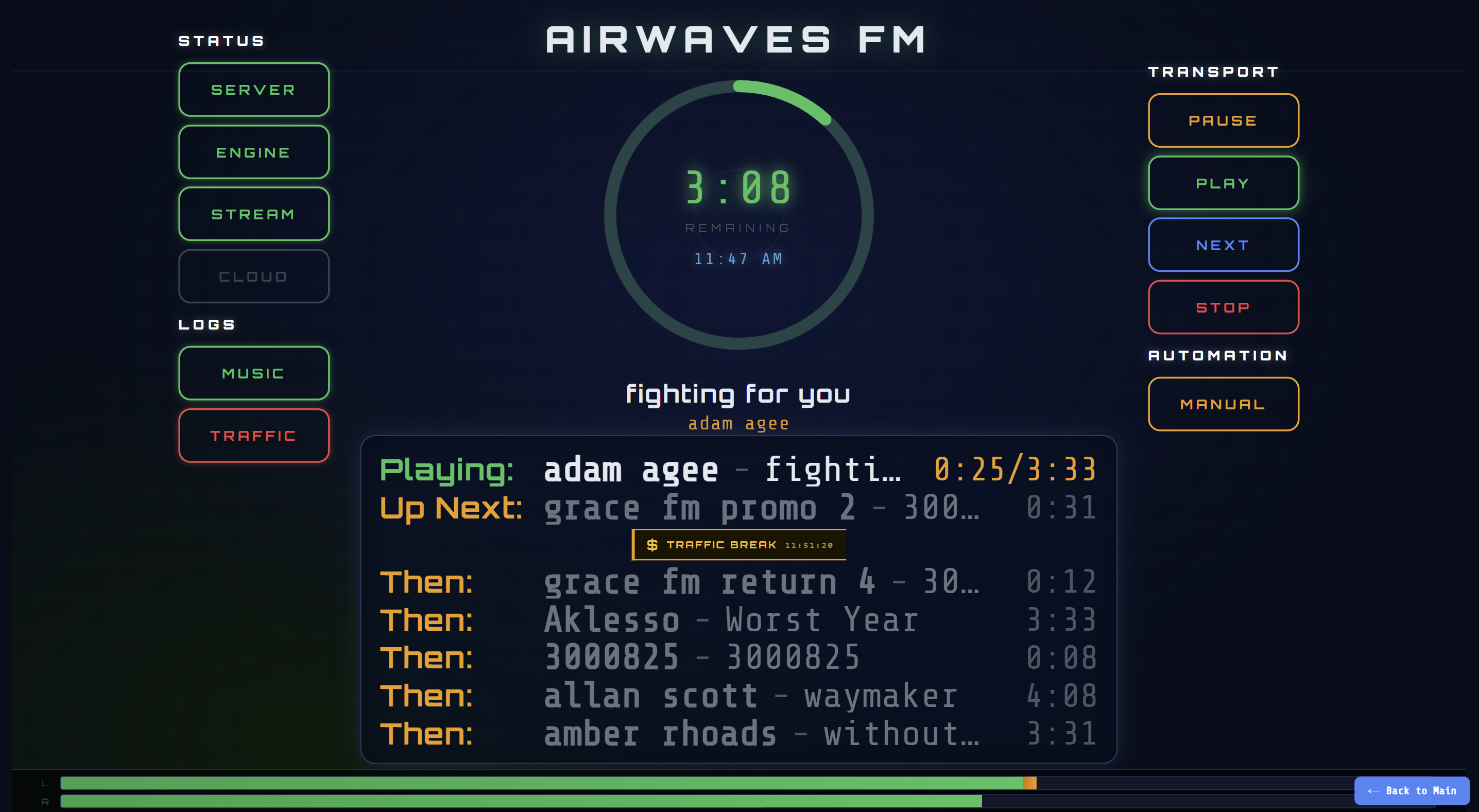
Radio automation, music scheduling, traffic scheduling, streaming and show prep normally mean five vendors, five databases, five contracts and a great deal of exporting and importing. In AirWaves they are one platform on one database — and each one is also available on its own, running against the automation you already own.
AirWaves is the whole station in one platform, but nothing here is locked to it. Every module was built to stand on its own and hand finished, standards-compliant output to whatever automation you already run — RCS, WideOrbit, Zetta, Simian, ENCO, Rivendell, StationPlaylist, NexGen, MusicMaster, Powergold, or anything else that reads a log or plays a file. Adopt one module, replace one weak link in your operation, and migrate the rest whenever you're ready — or never.
Build your logs in the most advanced music scheduler in radio and export them to your existing automation. Format clocks, the full rule tree, Shape of the Day energy flow and turnover analysis — no automation change required.
Every AI module writes a real, finished audio file — tagged, marked, loudness-matched, with full metadata — into any folder or library your automation watches. Sweepers, liners, promos, DJ breaks, weathercasts and newscasts drop straight into someone else's playout.
Run AirWaves Traffic against third-party playout: it exports spot logs your automation imports and reconciles the as-aired data back for billing, affidavits and network clearance. Your air chain doesn't move.
AirTools processing, the software profanity delay, the routing mixer and the streaming encoder sit in the signal path — they process and route whatever is driving the air chain, regardless of vendor.
Record and log any station's air, isolate each advertiser's spot automatically, and hand clients proof of performance — even if the automation feeding it isn't ours.
The website builder, app builder, persistent player with VAST insertion and listener request tools attach to any stream and any station, whatever puts it on the air.
Not seven vendors stitched together. The same engine that puts you on air builds your website, powers the app on your listeners' phones, and bills your advertisers — all connected, all in one place. Sell an ad once and monetize it everywhere: on the air, in the stream, on the site, in the app — every impression tracked and billed in one system.
AirWaves Automation runs as a true local system — the speed and rock-solid reliability of on-site, disconnected tech — while delivering the reach and scale of a distributed cloud platform. Nothing to install. No applications, no EXEs. The whole system runs in the browser, yet behaves like dedicated hardware in the rack. Easy to run, easy to recover, and built on a proprietary engine with custom algorithms found nowhere else.
It sees problems before they happen. The engine constantly self-monitors and runs forward-looking health checks — so instead of failing live, it can warn you: "the engine is showing early signs of trouble and may fault Thursday — switch to auxiliary and reboot the main now." Predictive recovery, not 2 a.m. dead air.
The first website builder built by broadcasters, for broadcasters. Element palette on the left, live preview on the right — drag an element onto the page, click it to open its settings, and what you build is what publishes. Start from a station template, then own every color, logo, font, and layout on your own domain.
A docked player bar keeps playing across every page your listener visits, streams your live audio with VAST pre-roll ad insertion built in, and shows the current track with auto-fetched album art. Now Playing reads real-time metadata straight from the stream so it never lags behind an ad break.
A complete broadcast console in the browser, driven by the real-time engine — every fader maps to a live audio operation, with the engine confirming the exact gain that reached the signal. Underneath it is a true routing matrix nothing else offers: send any bus or feed to any physical device, independently, from one screen.
Ask your station anything. The APD reads your real library, logs, scheduling rules, and clocks and answers in plain language — then suggests clock changes and grid changes to achieve the sound you're after, with full simulation so your PD sees the result before it's live. It always shows a preview and asks before it applies anything — the program director stays in control.
Weathercast pulls live conditions, a full multi-day forecast, and National Weather Service alerts — severe weather leads the cast automatically when it exists — then writes the on-air read in your choice of pro meteorologist or personality-DJ style, wrapped in your station's weather intro and outro, and voices it in your saved station voice. Forecast data is cached locally with a deterministic fallback, so air time never depends on an outside service being up — never dead air.
"…Right now in Cape Coral it's 93, LaBelle checking in at 90, and 92 in Fort Myers. Look for scattered afternoon storms, overnight low near 77 — your Gulf Coast forecast is brought to you by Sunshine Ford…"
The news twin of Weathercast. AI Newscasts assemble local, regional, and national stories from live feeds, write them for the ear at radio pace, and voice them in your station's news voice — timed to fit the break, wrapped in your news intro and outro, and dropped into your clocks like any other element. Small-market local news coverage that used to take a newsroom now airs around the clock.
"…AirWaves News time: 8 o'clock. Topping local news, the county commission approved the downtown riverfront project last night — construction starts this fall. Nationally, markets open higher this morning… I'm your AirWaves newsroom, back at the top of the hour."
The same builder thinking, for the app in your listeners' pockets. Arrange the station app by dragging in the surfaces you want — live player, now-playing, schedule, requests, dedications, listener texts — and ship a branded app tied to your live stream. No app developer, no separate vendor.
Drop an Advertiser element, set the creative and click-through, and every impression and click on your site is tracked automatically and routed through AirWaves Traffic for billing — the same system that runs your on-air and network advertising. One contract, one invoice, every placement. No competitor can say a website banner bills through the same traffic system as the on-air spot.
The AirTools Broadcast Audio Processor is a complete professional on-air chain — no rack of outboard gear, no plugin sprawl. Signal flows Source → AGC → Parametric EQ → Adaptive Auto-EQ → 5-Band Multiband → Solar Plexus bass, then splits into two final stages: an Air Path with an FM loudness clipper and a Stream Path with LUFS + true-peak — each tuned for its destination. It arms itself on startup and is processing from the moment you go live.
The Music Scheduler programs the energy of the day with a draggable 24-hour arc — Flow Sequencing builds each hour toward the energy you set. Around it: format clocks, a full rule tree, and a multi-day auto-build that feeds the automation engine directly. Traffic scheduling places and reconciles every spot, so programming, automation, and air are one continuous system — all built in, world-class, with no third-party scheduler and no exporting and importing logs. Nothing else on the market schedules the energy of an hour — and if you'd rather keep your current automation, the scheduler runs standalone and exports logs straight into it.
The Imaging Producer writes, voices and builds your station imaging. Give it a phrase library, your positioning statement, and your imaging voices, and it produces sweepers, liners, legal IDs, promos, show opens and topical drops — scored to beds, layered with SFX, loudness-matched, and filed straight into your imaging categories, marked and ready to air. What used to be a production day is a queue you approve. No other platform produces finished, on-brand imaging on its own.
"…Today's best country — and the songs you grew up on. 101-7, The Wolf."
Build a DJ persona — name, voice, attitude, how much they talk — and AirWaves voices real breaks between your songs: intros over the ramp, back-announces, time and temp, song and artist context, station trivia, and topical chat. The breaks are written from your actual log, so the DJ knows what just played and what's coming. A text-to-speech voice-talent library gives you studio-grade voices in any read style, and a persona grid lets you run a different jock in every daypart. Nobody else ships a DJ that talks about your log.
"…That's Strait — and this one spent five weeks at number one back in '92. It's 4:15, seventy-eight degrees on the Gulf Coast…"
Voice tracking runs in the browser with the log in front of you and the ramp, intro and EOM markers already set by the engine. Talent hears the outgoing song, the incoming song and their own take in context, and every take lands in the log placed and marked. Program directors get management tools no other system has: per-user daypart restriction, so a jock can only track their own hours; a cross-day pending-markers worklist; automatic advance to the next open marker; fill attribution recording exactly who filled which break and when; and a station coverage view showing every unfilled marker across the schedule at a glance.
A complete multitrack production editor lives in the same browser window as your log. Cut spots, build promos, layer voice over beds and SFX, and publish the finished cart straight into the library — tagged, marked and normalised, with no export step and no separate DAW licence. A dedicated Segue Editor gives you sample-level control of every transition on the log: overlap, ramp, fade shape and EOM, auditioned live through the real engine so what you hear is exactly what airs.
A full broadcast profanity delay runs in the engine: build delay transparently, dump on a key, and rebuild automatically — with no outboard box in the rack and no extra hardware to fail. Behind it, Word Watch and the Content Scanner analyse every file in your library, not just what's live: flagged language is surfaced before the song ever reaches a log, and you decide whether to tag it, restrict it by daypart, or pull it entirely. Library Health rounds it out with missing markers, bad metadata, duplicates and dead files caught before they embarrass you on air.
Request and tune-out tracking ties directly into the scheduler for better music scheduling. Every request is a vote, and every tune-out is a signal — AirWaves feeds both back into the rotation so your clocks reflect what's actually working with your audience. Requests respect your format: listener picks flow only into the clock positions you open, in a true managed queue, and on air a request sounds exactly like a scheduled spin, because it is one.
AirPhone is a 10-line call-in board your talent and screeners run from any browser — no hardware phone system. Callers reach you over a WebRTC caller page or your station's Telnyx SIP trunk. For interviews, a guest-login link lets a guest enter a code and join the studio session in the browser — no app, no phone number — for easy live broadcasts.
Whether you send a whole format, a produced show, or your live air, AirWaves carries it to any number of affiliates at once. Local breaks and split-copy fire automatically at each station, and cleared spots flow back into AirWaves Traffic for affidavits and network billing.
Deliver an entire format — clocks, categories, music, and imaging — to affiliate stations that air your programmed sound around the clock, kept fresh from the origin.
Distribute prerecorded and produced shows through AirVault. Every affiliate pulls clean, tagged, marked, ready-to-air files on schedule — no manual handoff.
Broadcast your live studio to unlimited affiliates with LiveSend. One feed goes out to every downstream station at once, with automatic local breaks and split-copy per affiliate.
AirVault keeps a protected, off-machine copy of your audio and content, so a failed drive, a wiped studio, or a lost machine is an inconvenience, not a catastrophe. Restore a single file or rebuild a whole library from the vault. And because AirWaves is engine-first, you can place a second AirWaves engine right at the transmitter as a live, hot backup — if the studio link drops, the transmitter-side engine keeps the station on air without skipping a beat.
Every site runs its own AirWaves engine on its own server — so on-air response is pure local and instant, with no round-trip to the cloud between a fader move and the air. Those local engines connect into one distributed platform you control from anywhere, giving you a single pane of glass over a national network or a single station. Local resilience, central command — manage one station as easily as a hundred.
Because the Skimmer records your air continuously and knows the log, AirWaves isolates each advertiser's spot automatically as it airs. Proof of Performance HQ collects every occurrence with its timestamp, and a branded client portal lets your advertiser log in and hear their own schedule as aired — no request to traffic, no digging through recordings, no waiting. Affidavits, invoices and as-aired reports come out of the same data, so nobody reconciles anything by hand.
When automation, scheduling, traffic, streaming and the website all run on one database, reporting stops being an act of reconciliation. Rotation and turnover dashboards show category health, spins and search depth. Listener analytics tie streaming sessions, requests, tune-out signals and app activity to what actually aired. Revenue, receivables, network clearance and yield reporting come from the same ledger that billed the spot. And a full audit trail records who changed what, when — across every module.
AirMonitor watches the actual audio leaving the station — silence, low level, stuck audio, a dead stream — and escalates before a listener calls. AirWatcher watches the machine underneath it: services, disk, database, engine health and network links, with the same forward-looking checks that let the automation warn you about a fault before it happens. Alerts route by station, by role and by time of day, so overnight problems reach the person who's actually on call.
Every other prep service sells the same thing: a sheet of stories a jock reads and retypes. AirWaves builds your whole prep rack overnight — headlines, entertainment, sports, weird news, trivia, birthdays, this-day-in-history — and then does what no outside service can: it reads tomorrow's actual music log and writes talk-ups fitted to the real intro ramp of each song, timed to land right where the vocal starts. Every story arrives in seven forms — tease, 10-second, 30-second, talk-up, phone-opener, take and social post — written in your format's voice. Build hour-by-hour Show Sheets, print at 5:40am, or email the night-before digest. And if nobody shows up, hand any item to the AI DJ and the break still airs, in the on-duty persona's voice.
Launch on any format you can name. AirWaves ships with professionally programmed libraries across every major radio format, and each one is more than a bulk music dump: songs are hand-curated, market-tested, and researched so the rotation reflects what real audiences actually respond to. Clocks, categories, and energy flow come pre-built and ready to tune to your sound — start airing in minutes, not months.
A complete faith-based offering — Contemporary Christian (CCM), Christian Hit Radio, Worship, Southern Gospel, and Christian AC — built for stations that lead with a message. Uplifting, family-safe rotations with the depth to program a full broadcast day, tuned to the artists and songs your congregation and community connect with.
The heart of American radio — the traditional country hits of the 1950s through the 1990s, from Hank Williams and Johnny Cash to Merle Haggard, George Strait, and Reba. A deep, well-researched Classic Country library that keeps loyal listeners locked in, with the era balance and gold rotation dialed in for your market.
Don't see your format, or run something all your own? AirWaves plays any library you bring — import your own music, blend formats, or build a custom sound. The scheduler, clocks, and processing adapt to whatever you put on the air.
Every spotlight above shares one engine, one database, one bill. That's what lets AirWaves do things the rest of the industry can't — because it was built from the engine up, in our own code. Judge any module on its own and it beats the specialist product it replaces; run them together and they do things no combination of separate vendors can. And every one of them will run against the automation system you already own.
Run your over-the-air signal and your online stream as independent, fully-automated chains simultaneously. Different ads, different content, different events firing on each — automatically, with no second system and no manual juggling. This is the single biggest gap in every other platform, and AirWaves closes it.
AirWaves detects Artist, Title, Intro and EOM and writes complete metadata and the markers themselves directly into every song — automatically. No other system sets markers in the file for you. Your library tags and cues itself.
The real-time audio engine and processing algorithms are written entirely in-house in C++ — not assembled from public libraries. That means performance, sound, and behavior we control end to end, and capabilities competitors can't license or copy.
No software to install on every studio machine, no per-seat client. The entire platform runs through the browser with custom interfaces — so any screen, anywhere, becomes a fully-capable control surface.
Drag-and-drop UI building, per user. Operators, PDs, traffic, and sales each get a surface tailored to their job — and can edit it themselves. PD lockdown keeps critical functions protected; every function is isolated and individually configurable.
A custom C++ engine drives playout with sample-accurate mixing, multi-output routing, and rock-solid timing — the core nothing else matches.
A full broadcast processing chain — AGC, multiband, EQ, bass, final limiting — applied independently to each source, not just the master.
Artist, Title, Intro and EOM detected and written into every file — markers and metadata set automatically as audio arrives.
Independent, automatic event triggers for your broadcast and your stream — different ads and content on each, at once.
Voicetrack and produce from anywhere — full production tools delivered through the browser, no studio seat required.
Format clocks, song categories, and a full rule tree — artist/title separation, sound codes, dayparting — generating balanced logs in-house.
Bring multiple live remote sources on air automatically — AirLink manages contribution feeds and switching without a hand on the board.
Weathercast and AI Newscasts write and voice themselves from live data and news feeds, air from your clocks, and carry sponsors — tracked and billed through traffic.
Playlist
Live controlsTake command of the live broadcast from a phone or tablet — fire events, take calls, drive segments, go live. The whole operation travels with you.
A full call-in system with ten lines, an integrated screener, and two-way texting — manage callers and listeners from one screen.
Screen callers, exchange texts with listeners, and queue the best calls to air — built into the talk-show workflow.
A software mixing surface that replaces the studio console: faders, routing, and processing without the hardware.
Connect remote talent, satellite studios, and field contributors into one unified air chain over the network.
Bring sources on and off air cleanly with automatic handling, monitoring, and failover.
Build branded listener mobile apps from the platform — your station in the app stores, tied to your live stream.
Complete traffic system — orders, copy, logs, breaks, and reconciliation — with multi-station and cluster scope built in.
Accrual-on-airing billing, double-entry journals, accounts receivable, and a lean chart of accounts — broadcast accounting, integrated.
Affiliate management, affidavits, and clearance — bill on cleared spots across a national network from one ledger.
Remote, on-site order entry for your sales team — and direct-to-air ad placement, so a sold spot can hit the log from the field.
Approved orders flow straight into the schedule — from sale to broadcast with the approval workflow you set.
Track clients, tasks, and approvals across sales, production, and traffic in one connected workflow and CRM.
Scans competitors' public political files and surfaces every political buy on their stations — so you know exactly which campaigns and PACs to target.
Political advertising files are public — and AirWaves reads them for you. The Political Ad Research tool scans your competitors' public inspection files and surfaces every political order running on their stations: who bought, which campaign or PAC, how much, and when it aired. Instead of guessing where the political money is going, you get a target list of exactly which candidates, committees, and issue groups to call — the ones already spending in your market.
A built-in music store with format subscriptions delivers fresh, broadcast-ready audio on a schedule — files arrive tagged, marked, and in your format. AirVault protects and distributes your content across the operation.
The built-in Skimmer continuously captures your air, so nothing is ever lost. Roll back the last hour, pull a clean aircheck of any break, or hand an advertiser proof-of-performance in seconds — all from one always-on recorder that runs quietly in the background.
Enterprise-class architecture spanning sites, clusters, and a national network — one platform, centrally controlled, locally resilient.
Manage and distribute content, logs, and configuration to many stations at once for true mass deployment.
Drag-and-drop interface building for every user — each person builds and edits the exact surface their role needs.
Program directors lock down critical functions; every function is isolated and individually configurable per user and role.
Integrated weather and Emergency Alert System handling — automated, compliant, and on air when it matters.
Each site runs its own dedicated server with our custom engine — your operation, your hardware, your data.
Nothing on this list is an add-on, a partner product, or a licence you buy separately — it all ships in the same platform, on the same database, under the same login. And like everything else in AirWaves, each of these will work alongside the automation system you already run.
Run a national network from one ledger: affiliate management, barter and cash orders, split-copy, affidavits, clearance and network billing — with affiliates on AirWaves or on someone else's automation.
Drop files in and the import pipeline does the rest: format conversion, LUFS measurement and normalisation, artist/title/intro/EOM detection, and auto-tagging into the right category — thousands of files at a time.
Push accurate now-playing to RDS, your stream, your website, your app and third-party directories — driven by what the engine actually played, not by what the log predicted.
Full trigger and relay handling for satellite networks, remote closures and external devices — start, stop, join and rejoin network programming automatically.
Configurable instant-play panels for jingles, drops, beds and effects — per user, per studio, per show, laid out however the talent wants them.
Chain any sequence of platform actions into a single command — smart carts that automate complex, multi-step tasks and fire from the log, a hot button, a trigger or a schedule.
An exclusive event scheduler that doesn't care how long an event runs, plus a live event monitor showing exactly what fired, what's pending, and what got skipped.
Sell against the stream and the site with dynamic, targeted ad insertion — separate from the over-air log, tracked and billed through the same traffic system.
Community announcements, PSAs, swap shop and event listings scheduled into the clock and published to the website and app at the same time.
Bring reporters, correspondents and remote talent into the operation with their own logins, upload paths and approval workflow — no VPN, no FTP.
Rotating cart groups with weighting, dayparting and expiry — for imaging, promos, PSAs and multi-copy advertiser schedules.
A full library manager over a centralised catalogue, with health analysis for missing markers, bad metadata, duplicates, dead files and category imbalance.
A managed library of studio-grade AI voices for imaging, DJ breaks, weather, news and spots — assign a voice per station, per element, or per persona.
Multi-party live contribution with automatic mix-minus — remotes, guests, satellite studios and field reporters brought on air without a board op.
Record a live show once and air it later on any station in the group, at any offset, with breaks and local content re-fired correctly for each airing.
Granular per-page, per-function permissions with program-director lockdown, per-user daypart limits and cluster-wide role management.
Every change to a log, clock, order, cart or setting is recorded with the user and timestamp — for compliance, for disputes, and for finding out what actually happened at 3 a.m.
Separate branded portals for advertisers, sales staff and station personnel — each seeing only what their role should see.
Integrated weather data and Emergency Alert System handling — automated, compliant, and on air when it matters.
Contextual help throughout the platform, so new operators get answers on the screen they're stuck on instead of in a PDF.
AirWaves doesn't wrap someone else's playout core or license a third-party audio engine. The engine, the processing, and the algorithms are ours — which is exactly why we can do what others can't.
A purpose-built real-time audio engine in native C++ — no public libraries — for performance and behavior we control end to end.
Processing and detection algorithms developed in-house, tuned for broadcast and impossible for competitors to license.
A complete processing chain on every source, not just the master bus — clean, consistent sound across the whole signal path.
Each location runs a dedicated server, networked into the cluster — local performance with central control and distribution.
AirWaves is all-in-one radio automation and playout software that runs your entire station from one platform: music scheduling, traffic and billing, AI radio imaging, AI DJ personas, voice tracking, multitrack production, live and produced syndication, streaming with ad insertion, software audio processing, a newsroom, a browser phone hybrid, and website and app builders. It runs in the browser with nothing to install on the studio machine. Every module is also available standalone and works with any third-party automation system.
Yes. Every AirWaves module is built to run standalone and feed any automation system — not just AirWaves. The music scheduler exports logs your current automation can read; AI Imaging, AI DJ, Weathercast and AI Newscasts write finished, marked audio files with full metadata into any library; Traffic and Billing exports logs and reconciles as-aired data from third-party playout; and the AirTools processor, profanity delay, skimmer, streaming encoder and virtual mixer sit in the signal path regardless of what is driving the air chain. You do not have to replace your automation to use them — adopt one module at a time and migrate on your own schedule.
Yes — full music scheduling is built in, not a bolt-on or a third-party integration. AirWaves music scheduling includes format clocks, Power/Current/Recurrent/Gold category rotations, a complete rule tree with artist and title separation, dayparting and sound codes, breakable and unbreakable rules across a multi-pass engine, optimum goals with graceful category fallback, turnover and search-depth analysis, and multi-day auto-build. Its exclusive Shape of the Day energy arc and Flow Sequencing let you program the feel of the hour, not just the song order — something no other music scheduler does. Because it feeds the automation engine directly there is no exporting and importing logs, and it also exports logs for third-party automation systems.
Yes. The AI Imaging Producer writes and voices sweepers, liners, promos, legal IDs and imaging phrases in your station's voices, with sound effects and beds, and drops the finished audio straight into your imaging categories — tagged, marked and ready to air. AI DJ personas voice breaks, intros, outros, trivia and song context in a persona you define, using a text-to-speech voice talent library. Both write standard audio files with full metadata, so they also work with any third-party automation.
Yes. Voice tracking runs in the browser from anywhere with in-context markers, per-user daypart restriction, cross-day pending-marker worklists, fill attribution and a Program Director station coverage view. A full multitrack production studio and audio editor is built into the same platform, along with a segue editor for fine playout control — no separate DAW licence and no studio seat required.
Yes. A software profanity delay runs in the engine with build and dump control, and Word Watch plus the Content Scanner analyse every song in your library for flagged language, alerting you and optionally flagging or removing the track before it ever reaches the log.
Yes. AirWaves includes a complete radio traffic and billing system with orders, copy, logs, breaks, reconciliation, accrual-on-airing billing, accounts receivable, a general ledger, network clearance, and multi-station and cluster scope. A sold ad can flow from order to air in minutes.
AirWaves syndicates three ways to unlimited affiliates: Format Syndication (an entire programmed format), Produced Syndication (prerecorded shows delivered through AirVault), and Live Syndication (live air via LiveSend). Local breaks and split-copy fire automatically at each affiliate, and cleared spots flow back into traffic for affidavits and billing.
No. AirWaves is delivered through the browser with no applications or EXEs to install on the studio machine, while the proprietary engine runs locally on one server per site for the speed and reliability of on-site technology plus the scale of a distributed cloud platform.
Yes. Weathercast builds AI-written, AI-voiced local weather from live forecast data and National Weather Service alerts — with rotating nearby-town temperatures — scheduled straight into your clocks, and it's sellable: sponsor flights can be tagged on or woven into the forecast and are play-tracked for billing. AI Newscasts work the same way for local and national news, voiced in your station's news voice and timed to fit the break.
AirWaves includes a full software broadcast audio processor: AGC, parametric EQ, adaptive auto-EQ, multiband compression, bass enhancement, exciter, stereo imaging and tube warmth, splitting into a separately tuned FM air path (loudness clipper) and stream path (LUFS and true-peak), with per-output loudness targets for FM, stream, mobile, podcast, and DAB+. It runs in the engine with no outboard rack, applies per audio source rather than only to the master bus, and can process the signal path for a third-party automation system as well.
Yes. The Skimmer records your air continuously and isolates each advertiser's spot automatically, so proof of performance is a click rather than an afternoon. Proof of Performance HQ and an advertiser client portal let clients see and hear their own schedule as aired, and the reporting suite covers as-aired logs, reconciliation, rotation and turnover dashboards, listener and request analytics, revenue and accounts receivable, and a full audit trail.
Yes. AirWaves Show Prep builds a full daily rack overnight — headlines, entertainment, sports, weird news, trivia, birthdays, this-day-in-history and more — and, because it owns your playout log, it writes talk-ups fitted to the exact intro ramp of the songs actually scheduled. Stories come in seven forms, from a five-second tease to a phone-opener question and a ready-to-post social. Jocks work from hour-by-hour Show Sheets, printable or emailed the night before, and any item can be handed to the AI DJ so the break airs even when nobody is in the studio.
Yes. Each site runs its own AirWaves engine on its own server for local, instant on-air response, and those engines connect into one distributed platform controlled from anywhere. Traffic, billing, network clearance, the music library and configuration are all cluster and network aware, so managing a hundred stations works the same way as managing one.
See AirWaves run your operation end to end. Schedule a demo by email or call 1-877-224-1656 — or try it yourself, a downloadable trial is on the way.
Tell us about your station and what you'd like to know. We'll get back to you personally — no bots, no phone tree.